
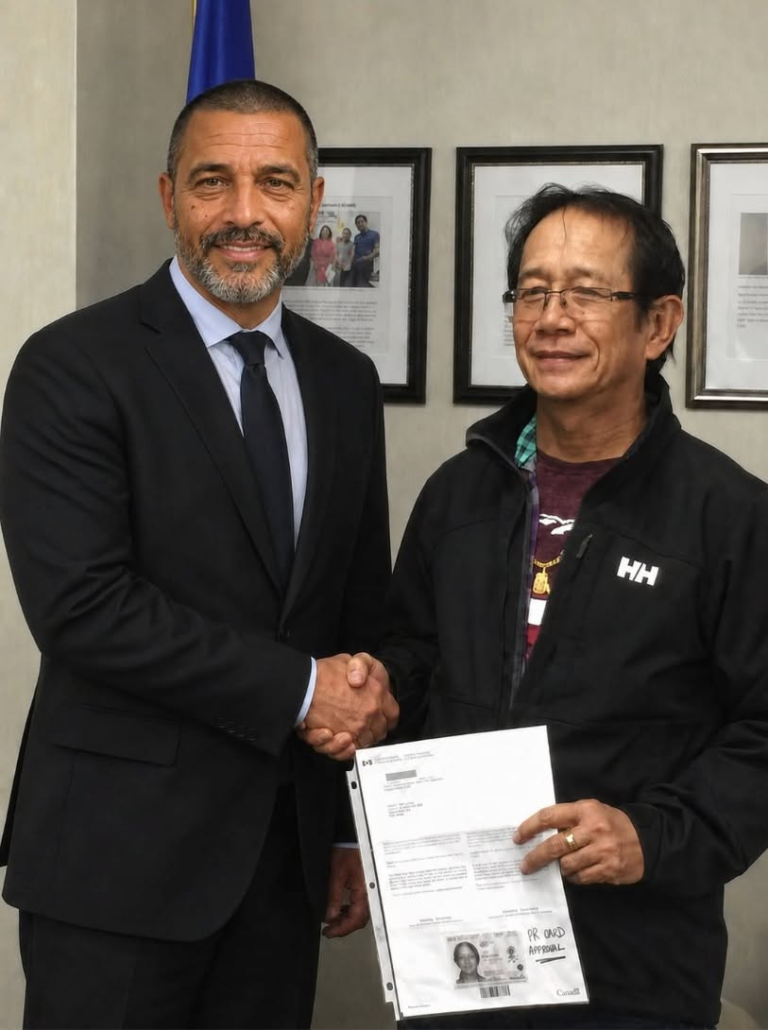
CLIENT SUCCESS STORY | JEREMY MENDES | PHILIPPINES  → CANADA

Four Years of Dedication, Progress and a Dream Fulfilled!
At Mengi Immigration Services Inc., some of our most rewarding moments come when we celebrate the long-term success of clients whose immigration journeys we have supported over the years.
Today, we are proud to celebrate Jeremy Mendes from the Philippines, who has successfully obtained Canadian Permanent Residence (PR) through the Federal Skilled Worker Program (FSWP).
Approximately four years ago, Jeremy first approached Mengi Immigration Services Inc. for assistance with obtaining a Canadian work permit. That was the beginning of his Canadian immigration journey.
After taking that important first step, Jeremy continued working towards his goal of establishing a future in Canada. Today, we are delighted to announce that he has achieved another significant milestone: becoming a Canadian permanent resident.
On September 4, 2026, Jeremy visited our Brampton office to share this wonderful news and celebrate this achievement with our team.
His journey demonstrates that there can be different pathways to Canadian permanent residence and that individuals who initially come to Canada as temporary foreign workers may also qualify for federal skilled worker immigration programs.
Understanding Jeremy’s Immigration Journey
Jeremy’s journey involved two important immigration stages.
Stage 1: Obtaining a Canadian Work Permit
Approximately four years ago, our team assisted Jeremy with his Canadian work permit application.
A work permit is an immigration document that authorizes a foreign national to work in Canada under specified conditions.
Depending on the type of work permit, an applicant may be authorized to work for a particular employer or, where eligible, for different employers.
For Jeremy, obtaining his work permit was an important first step towards beginning his Canadian experience.
Stage 2: Obtaining Permanent Residence Through the Federal Skilled Worker Program
After his initial work permit process, Jeremy eventually obtained permanent residence through the Federal Skilled Worker Program (FSWP).
Unlike the Canadian Experience Class, which focuses on qualifying Canadian work experience, the Federal Skilled Worker Program is designed for skilled workers who meet the program’s requirements, including qualifying skilled work experience, education, language proficiency and other selection factors.
This distinction is important for people who are interested in immigrating to Canada.
A person does not necessarily have to qualify through the Canadian Experience Class to become a permanent resident. Depending on their qualifications and circumstances, the Federal Skilled Worker Program may also be an option.
How Does the Federal Skilled Worker Program (FSWP) Work?
For individuals who want to understand the pathway Jeremy used, here is a simplified explanation of the process.
Step 1: Assessing Your Skilled Work Experience
The first step is determining whether your work experience meets the Federal Skilled Worker Program requirements.
Generally, applicants must have:
- At least one year of continuous, paid skilled work experience, or an equivalent amount of qualifying part-time work.
- Work experience within the previous 10 years.
- Experience in an eligible National Occupational Classification (NOC) TEER 0, 1, 2 or 3 occupation.
- Work duties that match the lead statement and most of the main duties of the selected occupation.
Importantly, qualifying experience may have been obtained inside or outside Canada.
This means that individuals with relevant skilled work experience from their home countries may also be eligible.
Step 2: Completing an Approved English or French Language Test
Language proficiency is another important requirement.
Applicants must complete an approved English or French language examination.
For the Federal Skilled Worker Program, the minimum language requirement is Canadian Language Benchmark (CLB) 7 or the equivalent in each of the four abilities:
- Speaking
- Listening
- Reading
- Writing
Language test results must remain valid at the relevant application stages.
Step 3: Educational Credential Assessment (ECA)
If an applicant completed their education outside Canada, they generally need an Educational Credential Assessment (ECA) for immigration purposes.
An ECA evaluates the applicant’s foreign educational credentials against Canadian educational standards.
This helps Immigration, Refugees and Citizenship Canada (IRCC) determine the Canadian equivalency of the applicant’s education.
Applicants with Canadian educational credentials generally do not need an ECA for those credentials.
Step 4: Meeting the 67-Point Selection Requirement
One important feature of the Federal Skilled Worker Program is its selection points system.
Applicants are assessed on six selection factors:
- Age
- Education
- Work experience
- Language proficiency
- Arranged employment, where applicable
- Adaptability
Applicants must generally score at least 67 points out of 100 to qualify under the Federal Skilled Worker Program selection grid.
It is important to understand that this 67-point requirement is not the same as the Comprehensive Ranking System (CRS) score used in Express Entry.
They are two separate assessments.
Step 5: Creating an Express Entry Profile
Once an applicant meets the Federal Skilled Worker Program eligibility requirements, they can create an Express Entry profile.
Express Entry is Canada’s online immigration management system for certain economic immigration programs, including:
- Federal Skilled Worker Program
- Canadian Experience Class
- Federal Skilled Trades Program
When an applicant enters the Express Entry pool, their profile receives a Comprehensive Ranking System (CRS) score.
The CRS considers several factors, including age, education, language proficiency and qualifying work experience.
Candidates are ranked against others in the pool, and IRCC issues invitations to apply for permanent residence through invitation rounds.
Meeting the FSWP eligibility requirements does not automatically guarantee an invitation. The applicant must also receive an invitation to apply.
Step 6: Receiving an Invitation to Apply (ITA)
If an applicant receives an Invitation to Apply (ITA), they can proceed with the permanent residence application.
This is an important milestone because it allows the candidate to submit a complete application for permanent residence within the specified deadline.
The applicant must provide the requested supporting documents and information.
Step 7: Submitting the Permanent Residence Application
Following an invitation, the applicant prepares and submits the permanent residence application.
Depending on the circumstances, supporting documentation may include:
- Valid passport and identity documents.
- Employment reference letters and proof of qualifying work experience.
- Educational certificates and ECA reports.
- Approved language test results.
- Police clearance certificates.
- Medical examination results, when required.
- Proof of funds, where applicable.
- Other supporting documents requested by IRCC.
IRCC reviews the application to determine whether the applicant meets the applicable immigration and admissibility requirements.
Step 8: Permanent Residence Approval
Once IRCC approves the application, the applicant receives the appropriate permanent residence confirmation documents.
Depending on the applicant’s circumstances, this may include a Confirmation of Permanent Residence (COPR) and completion of the applicable landing or virtual confirmation process.
The applicant can then officially become a Canadian permanent resident.
This is the milestone we are proudly celebrating with Jeremy today!
An Important Lesson for Temporary Foreign Workers
Jeremy’s journey carries an important message for individuals who are currently working in Canada or considering coming to Canada through a work permit.
A Canadian work permit and Canadian permanent residence are two different immigration statuses, but one does not prevent you from pursuing the other if you qualify.
Coming to Canada as a temporary foreign worker does not automatically lead to permanent residence. However, there may be opportunities to qualify for different immigration programs depending on your education, work experience, language ability, age and other eligibility factors.
The Federal Skilled Worker Program is particularly important because qualifying skilled work experience does not have to be obtained exclusively in Canada.
This means that applicants with qualifying foreign work experience may also have an opportunity to pursue Canadian permanent residence.
The most important thing is to understand your eligibility and identify the appropriate immigration pathway before submitting an application.
Congratulations, Jeremy Mendes!
We are sincerely grateful to Jeremy for trusting Mengi Immigration Services Inc. approximately four years ago with his initial work permit application and for allowing us to be part of his immigration journey.
Today, we celebrate not just a successful permanent residence outcome, but the dedication and determination that brought him to this milestone.
From the Philippines to Canada, from a temporary work permit to permanent residence, Jeremy’s journey is one we are proud to share.
Congratulations, Jeremy! We wish you continued success, happiness and prosperity as you build your future in Canada.
Are You Hoping to Become a Canadian Permanent Resident?
Whether you are currently in Canada on a work permit or living abroad and considering Canadian immigration, understanding your options is the first step.
At Mengi Immigration Services Inc., we provide professional immigration guidance and assistance with applications based on individual circumstances and applicable immigration requirements.
Our team can help assess your qualifications, explain available immigration pathways and guide you through the application process.
Your journey may be different from Jeremy’s, but the right information and proper preparation can help you make informed decisions about your future.
Mengi Immigration Services Inc.
Professional guidance. Personal attention.
Mengi Shamnik Immigration
RCIC Number: R712729
Email: rcic@
Telephone: +1 (647) 499-8498
Location: Brampton, Ontario, Canada
Client Success Story: Jeremy Mendes
Date: September 4, 2026
Privacy Notice: Client success stories and photographs are shared with permission. Every immigration application is assessed individually by IRCC. Immigration eligibility, processing and outcomes depend on the applicable requirements. Previous successful applications do not guarantee future results.